 Download Full Technical Report Here
Airbrakes Sub-team Lead · 2025–2026 IREC Cycle
Sabre III is UVA Rocketry's third entry into the International Rocket Engineering Competition (IREC), built for the 10k COTS category. The rocket stands 10'4" tall with a 6.17" outer diameter, launching on an Aerotech M2500T motor toward a projected apogee of 10,027 ft AGL — a new airframe built around lessons learned from Sabre II's 2025 championship run.
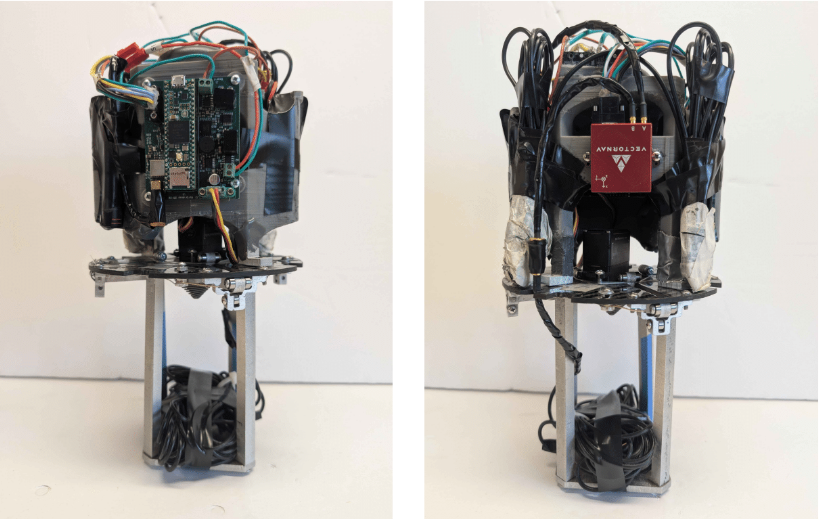
As returning Airbrakes Lead, I carried the sub-team into this new project cycle, redesigning the active drag system around a novel winder-based deployment mechanism and refining the onboard apogee prediction software to within 10 feet of target altitude in simulation.
Sabre III carries forward the fiberglass nose cone, upper airframe, and booster tube layout that's become the team's competition baseline, but nearly everything inside is new. The booster tube features a student-designed aluminum boat-tail motor retainer and four carbon-fiber fins with tip-to-tip reinforcement. Four internal subsystems — recovery, airbrakes, payload, and a live video system — share the airframe, with recovery avionics and video now consolidated into a single, more space-efficient avionics bay.
Sabre II's airbrakes relied on a cam-driven petal system with a spring-powered fail-safe retraction. For Sabre III, the sub-team moved to a new winder-based deployment mechanism, aiming to improve reliability and control precision over the previous cam-and-petal design. Apogee prediction software was also refined, reaching an accuracy of within 10 feet of the 10,000 ft target in simulation — a meaningful improvement over prior years' models.
Before competing at IREC, Sabre III had to clear a full ground-test and flight-test campaign. Ground ejection testing for the drogue and main parachute separation was completed February 28–March 1, 2026, followed immediately by a successful sub-scale flight test that same afternoon. After a payload design change, a second round of main-separation ground testing followed on March 13, and a second sub-scale flight test on April 11 confirmed the design was flight-ready with no further major changes needed before the competition.
Returning to lead Airbrakes on a second, redesigned rocket meant applying everything learned from Sabre II's cam-driven system — where it held up under competition conditions and where a cleaner mechanical approach could reduce failure points. The winder-based mechanism and tighter apogee prediction reflect that iteration: not a bigger system, but a more deliberately engineered one.