Aerodynamics Lab · UVA Aerospace Research Laboratory · May 2026
This lab characterized compressible flow behavior in UVA's supersonic blowdown wind tunnel, comparing theoretical and measured blowdown time, contrasting started vs. unstarted flow conditions, and cross-validating Mach number across three independent measurement methods.
Testing used UVA Aerospace Research Laboratory's open-circuit blowdown supersonic wind tunnel, which uses a converging-diverging nozzle with an adjustable sliding block to control test-section Mach number. A twelve-tap ScaniValve pressure sensor recorded static wall pressure along the upper block, while a shadowgraph system visualized shock structure and density gradients around a wedge-shaped test article. Stagnation pressure, nozzle throat area, and the article's angle of attack were varied across the test matrix.
Comparing the theoretical blowdown time — calculated from tank volume, stagnation conditions, and a theoretical mass flow rate — against the stopwatch-measured experimental time yielded a 10.99% error, which is reasonably attributed to the limits of manual timing rather than a flaw in the underlying mass flow model.
At 40 psi, no shock was visible in the shadowgraphy and the pressure trace showed a sharp spike just past the nozzle throat — the signature of a normal shock in the diverging section preventing supersonic flow from reaching the test section. At 50 psi, the pressure trace instead decayed smoothly toward the test section, confirming a fully started, supersonic flow.
Mach number was calculated three independent ways: from nozzle exit-to-throat area ratio using isentropic flow tables, from the highest static wall pressure reading in the test section, and from the observed oblique shock angle around the wedge using θ-β-M relations. The three methods agreed closely at the lower blockage positions but diverged more at higher restriction settings, highlighting where each method's underlying assumptions started to break down.
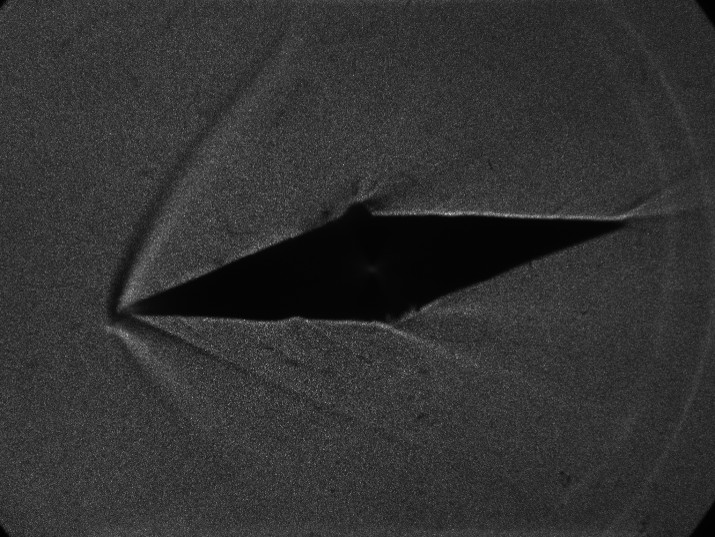
Shadowgraph imaging captured the wedge test article at two angles of attack. At -7°, no clear shock structure formed — the flow reaching the article was already subsonic. At -9°, the images showed a well-defined bow shock off the top edge (~51°) and an attached oblique shock off the bottom edge (~34°), along with clear expansion fans at the leading, trailing, and lower edges.